How to Make Reels Without Showing Your Face
Plenty of small-business owners assume Reels mean standing in front of a camera, talking and smiling. If that makes you want to close the app, here's the good news: a face is optional. Some of the steadiest business accounts never show one. Instagram's ranking leans on whether people watch your video, finish it, save it, and send it to a friend — none of which require your face. Below are the faceless formats that hold up, and how to shoot them on a normal phone in a normal week.
Do faceless Reels actually perform, or is a face better?
Faceless works because the algorithm is watching the viewer, not you. Reels are now roughly a third of all time spent on Instagram, and the format reaches further than any other post type — Buffer's analysis of over 4 million posts found Reels get more than double the reach of single-photo posts. A lot of that reach lands on people who don't follow you yet, which is exactly where new customers come from. So the question isn't "is my face in this," it's "does this hold attention for ten seconds, and is it worth sending to someone." A pair of hands plating a dish, a screen recording of a useful trick, a satisfying before-and-after — all of those clear the bar.
A face can build a personal brand faster, and for some businesses that's the point. But it's a preference, not a requirement. If being on camera is the thing stopping you from posting at all, faceless isn't a compromise — it's the way you actually start. The worst Reel is the one you never make because you didn't want to film yourself.
What are the faceless Reel formats that work for a small business?
You don't need all of these. Pick two or three that fit what you do and rotate them.
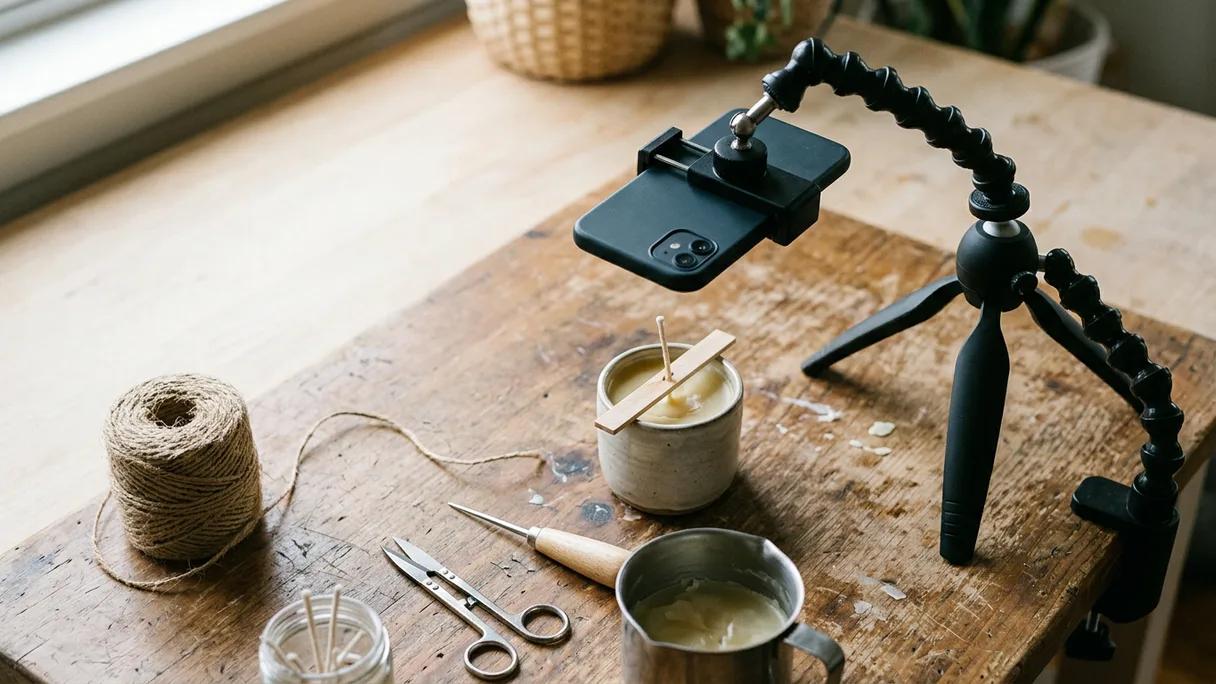
- Hands-only how-to. Just your hands doing the work — frosting a cake, wrapping a bouquet, threading a sewing machine, pouring a candle. Top-down or over-the-shoulder. This is the workhorse format for any business that makes or fixes something.
- Before-and-after. A messy room and the finished room. A blank wall and the mural. Tired hair and the fresh cut. Hold on the "before" for a beat so the "after" lands. These get saved and shared because the payoff is obvious in two seconds.
- Screen recording. For anything digital or service-based: a quick walkthrough of a feature, a template you use, three settings most people miss. Record your screen, add a text headline, done. No camera at all.
- Product close-ups (B-roll). Slow, well-lit shots of the thing you sell, cut to the beat of trending audio. Texture, packaging, the moment it gets used. Works for food, skincare, crafts, anything tactile.
- Text-on-screen list or tip. A simple background — your shelf, your workspace, a clean color — with one punchy text point per beat. "3 mistakes people make booking a photographer." Cheap to make, easy to batch.
- Behind-the-scenes process. The order getting packed, the prep at 6 a.m., the stock arriving. No narration needed. People like seeing how the work actually gets done.
- Voiceover over B-roll. If you're fine with your voice but not your face, talk over footage of your work. Your voice carries the expertise; the footage carries the eye.
- Customer results or testimonials. A screenshot of a kind message, a photo of the finished job, a quick clip of the client's reaction (with permission). Social proof that never needs you on screen.
How do I film a faceless Reel on just my phone?
The mechanics are simpler than the formats suggest. A phone, daylight, and a steady surface cover most of it.
- Light it from the front. Face a window and put your work between you and the light. Overhead kitchen lights cast shadows; a window doesn't. This one change makes phone footage look intentional.
- Steady the shot. Prop the phone on a stack of books, a clip stand, or a cheap mini tripod. Shaky handheld reads as careless. Locked-off and clean reads as a brand.
- Shoot more than you need. Film the whole action, then a couple of close-ups. You'll cut it down to the good twelve seconds, and the extra clips give you something to work with.
- Cut to the action. Trim the dead air at the start. The first frame should already be doing something — hands moving, the after revealed, the screen mid-scroll.
- Keep it short. For most faceless formats, 15 to 30 seconds is the sweet spot: long enough to deliver, short enough to finish. A genuinely useful tutorial can run longer, but start short.
How do I write a hook for a Reel with no face or talking?
When there's no face and no voice, your text overlay is the hook. It has to do the job a talking head normally does: tell the viewer in the first second why to keep watching. Put a single bold line of text in the opening frame and make it a promise or a problem.
- Promise: "How I pack 40 orders in under an hour."
- Problem: "Your candles tunnel because of this one mistake."
- Curiosity: "The before will hurt. The after is worth it."
- Specific number: "3 things I wish I knew before opening a bakery."
Keep the hook readable on a small screen — short, high-contrast, and not buried at the bottom where the caption covers it. Then let the caption carry the detail and the call to action. A faceless Reel leans harder on its caption than a talking one does, so write a real first line and a clear next step ("Save this for your next batch," "DM the word PRICES").
How often should I post faceless Reels, and how do I keep it sustainable?
Consistency beats perfection, and faceless formats are built for it because they batch well. Set up your phone once, film four hands-only clips back to back, and you have a week or two of content. The same goes for screen recordings and text-on-screen tips — make five in one sitting.
Don't chase a daily streak you can't keep. Two or three Reels a week, every week, will out-perform a frantic seven-then-nothing. Reuse what works: if a before-and-after does well, do that format again with a different job. Repeating a structure people clearly like is a feature, not a problem.
If even batching feels like one more job you don't have time for, that's the problem Laspi Pro is built for. You send a weekly voice note — "here's what we did this week" — and a few photos, and it comes back as a week of ready-to-publish posts written for each platform, captions and hooks included. You review, tweak anything that's off, and publish. The faceless Reel ideas above still apply; Laspi Pro just turns your week into the plan and the words, so you're not staring at a blank caption box on a Sunday night.
Which faceless format should I start with this week?
Pick the one that matches what you already do without setup. If you make something with your hands, film a hands-only how-to. If your work is digital, record your screen. If you do transformations, shoot a before-and-after on your next job. Don't build a content system first — make one Reel in a format you can repeat, post it, and watch what happens. The format that earns watch time is the one to keep.
Frequently asked questions
- Can you grow on Instagram without showing your face?
- Yes. Instagram ranks Reels mostly on watch time, saves, and shares, and pushes them to people who don't follow you yet — none of which depends on a face appearing. Faceless formats like hands-only demos, before-and-afters, and screen recordings grow accounts every day.
- What is the best faceless Reel format for a service business?
- Screen recordings and customer-results posts tend to work best. A quick walkthrough of a tip, template, or process shows your expertise without you on camera, and screenshots of happy clients provide social proof. Both are fast to produce and easy to share.
- How long should a faceless Reel be?
- For most faceless formats, 15 to 30 seconds is the sweet spot — long enough to deliver value, short enough that people finish it. Genuinely useful tutorials can run longer, but start short and trim any dead air at the beginning.
- Do I need special equipment to make faceless Reels?
- No. A phone, a window for light, and something to prop the phone steady cover most of it. A cheap mini tripod helps for top-down shots, but you can start with a stack of books today.
- How do I hook viewers in a Reel with no face or voiceover?
- Use a bold text overlay in the first frame that states a promise, a problem, or a number — for example, "3 mistakes people make booking a photographer." Then let the caption carry the detail and a clear next step like "Save this" or "DM for prices."
Sources
- Teleprompter (citing Meta data), 2025 — Reels account for roughly a third (about 35%) of total time spent on Instagram in 2025.
- Buffer, 2025 — Instagram Reels get more than double the reach of single-photo posts and 1.36x the reach of carousels, based on an analysis of over 4 million posts — making Reels Instagram's highest-reach post format.