How to Use AI for Social Content Without Sounding Generic
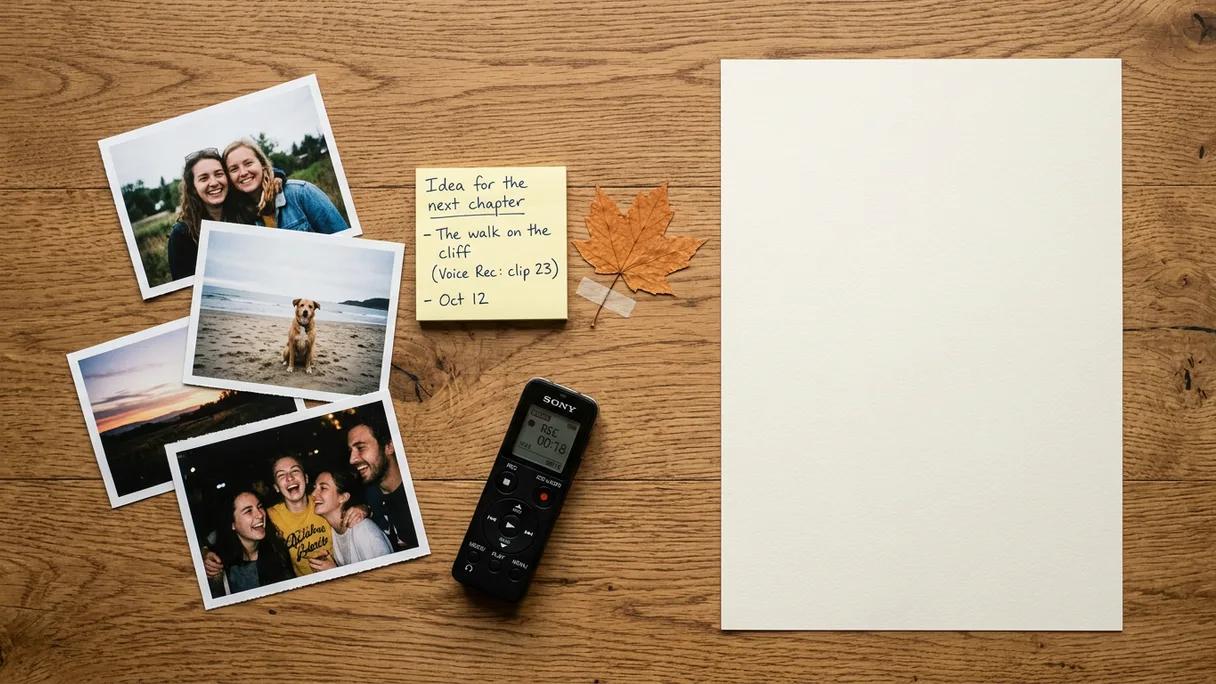
You recorded a voice note this morning about a new product, a busy weekend, a customer who said something funny. That is the raw material AI can't invent. The trick to non-generic AI content is to stop asking AI to come up with posts and start asking it to shape what you already have — your words, your photos, your specifics — into something you can publish. Here is how to do that, step by step, in a way you can actually keep up with.
Why does AI social media content look so generic?
Because most people prompt it from nothing. "Write me five Instagram captions about my coffee shop" gives the model no facts to work with, so it reaches for the average of every coffee shop online: "Start your morning right," "Treat yourself today," a few emojis, a generic call to action. It reads like a stock photo because, statistically, that is what it is: the blurry middle of a million similar posts.
The fix is not a better tool. It is better input. When you feed AI real, specific material — the name of the new espresso blend, the regular who orders it, the fact that you switched roasters last week — it has something concrete to build on. The output stops sounding like everyone and starts sounding like you, because the details are you.
What's the difference between AI from your material and AI from thin air?
"Thin air" prompting asks the model to be creative on a topic. "From your material" prompting asks it to be a writer working from your notes. The second job is the one AI is genuinely good at. It can't know what happened in your shop this week, but give it the facts and it will phrase them cleanly across four platforms in a few seconds.
This matters for reach, not just taste. With its March 2024 core update, Google said it expected to reduce low-quality, unoriginal content in search results by 40%, targeting pages built primarily for search engines rather than people — regardless of whether automation, humans, or a combination produced them (Search Engine Journal, 2024). Social platforms reward the same thing in their own way: specific, original posts get saved and shared; generic ones get scrolled past. Originality is the whole point.
How do I capture raw material I can feed to AI?
You need a low-effort way to dump what's actually happening, because if capturing it feels like homework, you'll stop. A few habits that work for busy owners:
- Talk, don't type. Record a 2-3 minute voice note once a week: what's new, what sold, what a customer said, what you're proud of. Speaking is faster than writing, and it catches the offhand details that make content feel real.
- Photograph the boring stuff. The half-finished order, the messy workbench, the morning light on the shelf. You don't need a photoshoot, you need proof you exist. Real photos beat polished stock.
- Keep a running notes file. One line whenever something happens: a five-star review, a new supplier, a mistake you fixed. By the end of the week you have a week of material without ever sitting down to "create content."
- Save customer language. The exact words people use in DMs, reviews, and at the counter. Those phrases make your best captions, and no AI can guess them.
This is the part only you can do. Everything after it can be assisted.
How do I prompt AI so the output sounds like me?
Give it three things every time: your raw material, your voice, and the platform. Skip any of them and you slide back toward generic. A simple structure:
- Paste the facts. Your voice-note transcript or notes, unedited. Messy is fine; the details are what matter.
- Describe your voice in one line. "Plain, warm, a little dry. No emojis, no exclamation marks, I talk like a person, not a brand." Better yet, paste two or three of your own past posts and say "match this."
- Name the platform and the job. "Turn this into one Instagram caption and one shorter Threads post. Lead with the most surprising detail."
Then edit. Always edit. Cut the one sentence that sounds like a press release, swap a phrase for how you'd actually say it, and you're done. The model did the assembly; you did the judgment. Machine speed, human taste.
Does it matter that my content isn't perfectly polished?
It helps that it isn't. In Stackla's consumer content survey, 90% of people said authenticity is important when deciding which brands they support, and 79% said user-generated, unpolished content highly impacts their purchasing decisions — versus just 13% for brand-made content (Nosto/Stackla, 2019). That gap points one direction: people trust content that looks like a real person made it.
The goal isn't content that looks expensive. It's content that looks like you — the thing a competitor, or an AI working from nothing, can't reproduce.
So don't sand off the edges. Keep the specific number, the slightly awkward true detail, the photo that isn't centered. AI is there to save you time on phrasing and formatting, not to launder your business into a generic brand.
How do I adapt one idea for different platforms without copy-pasting?
Same raw material, different shape. One voice note can become a longer story-driven Instagram caption, a punchy Threads post, a TikTok hook plus on-screen text, and a slightly more buttoned-up Facebook version. The facts stay constant; the format and length change. This is exactly the repetitive reformatting AI handles well: ask it to produce all four from the same input in one pass, then tweak each.
A practical rule: lead each platform's version with a different detail from the same note. Instagram opens with the story, Threads opens with the opinion, TikTok opens with the question. One event, four angles, none of them duplicates.
This is the workflow Laspi Pro is built around. You record a weekly voice note and add a few photos, and it turns them into a week of ready-to-publish posts shaped for each platform — drawn from your actual material, not generated from nothing. You review, adjust anything that doesn't sound like you, and publish. You keep the part only you can do (the raw, real input) and hand off the part that eats your evenings (the reformatting).
What should I never let AI do?
Three things. Don't let it invent facts: if it adds a claim, a number, or a customer quote you didn't give it, cut it, because made-up details destroy the trust you're trying to build. Don't let it set your voice: feed it yours, or it defaults to bland. And don't post unread: a thirty-second skim catches the one off-brand line every time. Keep those three rules and AI becomes a fast assistant working from your reality, which is the only version that doesn't look generic.
Frequently asked questions
- Why does my AI-generated content sound generic?
- Because it's prompted from nothing, so AI defaults to the statistical average of similar posts online. Give it your real specifics — a voice note, your photos, your customers' exact words, and a sample of your own writing — and the output stops sounding like everyone else.
- Will Google or social platforms penalize AI-written content?
- Not for being AI-written specifically. Google's March 2024 core update targets low-quality, unoriginal content built primarily for search engines rather than people, whether a human or a machine made it. Original, specific content built from your real material is rewarded; thin, generic content is not.
- How do I make AI match my brand voice?
- Tell it in one line how you sound ("plain, warm, no emojis") or, better, paste two or three of your own past posts and ask it to match them. Then always edit the output to swap in phrasing you'd actually use.
- What raw material should I collect to feed AI?
- A short weekly voice note on what's new, real unpolished photos, a running one-line notes file, and the exact language customers use in reviews and DMs. These specifics are the part only you can supply, and they're what make content non-generic.
- Can one piece of content work across Instagram, TikTok, Facebook, and Threads?
- Yes, if you reshape rather than copy-paste. Keep the same facts but change the format, length, and opening detail for each platform. AI is good at producing all four versions from one input, which you then lightly tweak.
Sources
- Search Engine Journal, 2024 — With its March 2024 core update, Google said it expected to reduce low-quality, unoriginal content in search results by 40%, targeting pages built primarily for search engines rather than people, regardless of whether automation, humans, or a combination produced them.
- Nosto (Stackla Consumer Content Report), 2019 — 90% of consumers say authenticity is important when deciding which brands they support, and 79% say user-generated content highly impacts their purchasing decisions, versus 13% for brand-created content.